
Is the Netherlands in Germany? But Seriously…


Wondering if the Netherlands is in Germany? You’re not alone—and you’ve come to the right place!
While these two countries share a border, they are completely separate nations with their own histories, cultures, and languages.
Fun fact: Gavin is part German, and we’ve visited both countries multiple times—so we know the difference firsthand!
In this post, we’ll clarify the geography, explore their unique histories, and highlight what makes each country worth visiting.
By the end, you’ll know exactly why the Netherlands is not Germany… and why both are amazing travel destinations.
Let’s dive in!
Plan Your Trip with My Favorite Resources
🔹Book the best hotels: Booking.com
🔹Find great flight deals: Skyscanner
🔹Reserve a rental car: Discover Cars
🔹Purchase travel insurance: InsureMyTrip
🔹Book a day tour: Viator
🔹Easily stay connected: Airalo
➡️Check out all our Travel Resources here!
Is the Netherlands in Germany?

No. The Netherlands is not in Germany. Is the Netherlands part of Germany, then? Nope.
The Netherlands is a separate country in northwestern Europe. Germany is a neighboring country to the east of the Netherlands.
Both countries speak German, share a border, and are located in northwestern Europe.
So if you’re wondering about visiting Amsterdam during winter, be prepared. It does snow in the Netherlands and Germany. But that is where the similarities end.
They are distinct, separate nations with their own governments, cultures, and histories.
And yes, the Netherlands and Germany are both worth visiting. You could travel them separately or combine them into one epic adventure!
Combining destinations into one trip can help you spend less money while traveling.
We visited them on two different trips to get an in-depth experience with each. Germany is quite large and the Netherlands, though smaller, has so much to see!
Where is the Netherlands?

First, let’s get the geography right. Where is the Netherlands exactly?
The Netherlands is a country located in northwestern Europe. It is bordered by Germany to the east, Belgium to the west, and the North Sea to the north.
So combining Netherlands with Belgium or Germany on one trip is possible!
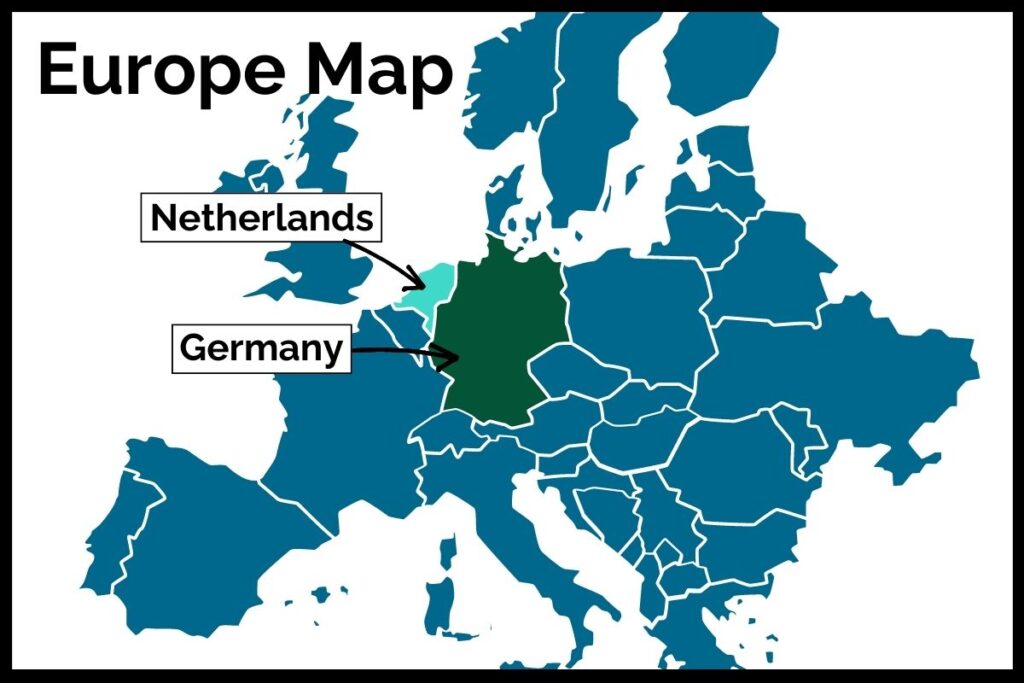
The Netherlands is also sometimes referred to as Holland, even though this is technically a region within the country.
So now you know! Germany is the Netherlands’ larger next-door neighbor in northwestern Europe.
About The Netherlands


The Netherlands is a small country in Western Europe. It has a land size of 41,543 sq km which is about the same size as Switzerland.
It is known for its beautiful canal towns, iconic architecture, traditional windmills, colorful tulips, tasty cheese, laidback vibe, and cycling culture.
We got to experience the friendly Dutch culture and traditions first-hand when we spent two weeks in the Netherlands. We highly recommend visiting this little gem.
Amsterdam, the capital of the Netherlands, is one of the most beautiful cities in Europe with so many amazing attractions!
Highlights of this city include relaxing canal cruises, wandering the pedestrian-only alleys, touring world-class museums, and visiting the Red Light District.
There are even wheelchair friendly accommodations if you travel with a disability!

The Netherlands is renowned for its progressive social policies such as legalizing same-sex marriage.
It is respected worldwide for its commitment to environmental sustainability and its contributions to art and science.
The Netherlands Fun Facts:
✔️22nd smallest country in Europe
✔️made up of 40 islands
✔️it has 451 km of coastline
✔️26% of the country is below sea level
✔️59% of its land mass floods… so get your dingy ready!
Population

The Netherlands has a population of 17.6 million.
It is one of the most densely populated countries in Europe. Most people live in the urban areas of Amsterdam, Rotterdam, and The Hague.
This means that when you travel to Amsterdam, chances are… it will be crowded with locals and tourists!
✅HELPFUL TIP: Beat the line at museums and landmarks
with the Amsterdam City Pass
The Dutch population is diverse and multicultural. A high number of immigrants come from Turkey, Suriname, Morocco, the Netherlands Antilles, and Aruba.
The population is also relatively young. The median age is 42 years old, and over 50% of the population has a high level of education and income.
Language

The official language of the Netherlands is Dutch. It is also spoken in other countries, like Aruba, Curaçao, Suriname, and Belgium.
But if you don’t speak Dutch, don’t worry! 90% of people speak English in the Netherlands.
English is used in business, education, international communication, and the travel industry. So, you will have no problem getting around the Netherlands on your holiday!
And if you’re wondering, does the Netherlands speak German? Yes, about 71% of people speak German. And about 29% speak French.
Seems that most of the Dutch are fluent in 3-4 languages. I’m a little jealous…
We combined our trip to the Netherlands with Belgium and we heard more languages spoken than in any other country we have visited.
And, we have traveled to 46 countries!
Brief History


The Netherlands has a fascinating past. The country was built on flat, swampy land next to the North Sea.
The Dutch began to build windmills and dikes made from mud to protect the low-lying areas from flooding by the sea. Over the centuries, they improved their dike-building skills and pushed the sea back out.
By the 17th century, the extensive network of dikes, dams, and windmills helped them reclaim huge areas of land from the sea.
Canals and pumps were used to drain the land, keep it dry, and turn it into successful farmland.
The 17th century, known as the Golden Age, saw the Netherlands gain its independence and become a powerhouse in trade, art, and scientific achievements.
Amsterdam was one of the wealthiest cities in the world. Dutch painters Rembrandt and Vermeer made their mark on the art scene.
And Martin Luther and John Calvin influenced Dutch religious and cultural life.
The Netherlands became a colonial power, spreading its influence far and wide. But, as history often goes, they eventually lost some of those colonies.
In the 19th and 20th centuries, the Netherlands made significant social, economic, and political changes. They abolished the monarch, established democracy, and became a leader in international law and diplomacy.
Today, the Netherlands is a modern, prosperous country with a high standard of living and a diverse culture. They are known for being super tolerant, open-minded, innovative, and socially progressive.


Quick Facts: Germany vs. Netherlands
| GERMANY | NETHERLANDS | |
| Languages | German (Other: English, French, Russian) | Dutch (Other: English, German, French |
| Population | 83 million | 17.5 million |
| Size | 7th largest country in Europe. Total land area: 357,582 sq km | 22nd smallest country in Europe. Total land area: 41,543 sq km |
| Capital City | Berlin | Amsterdam |
| Leader | Olaf Scholz | Mark Rutte |
| Average Income | €49,260/year (2022) approx. ($55,191 USD) | €39,900/year (2022) approx. ($44,688 USD) |
| Famous People | Albert Einstein: 20th-century scientist known for Theory of Relativity Beethoven: A highly celebrated classical composer Angela Merkel: Chancellor of Germany from 2005 – 2021 | Vincent van Gogh: Post-impressionist artist who painted “Starry Night” Anne Frank: Holocaust victim who wrote “The Diary of a Young Girl” during Nazi Occupation in Holland Eddie van Halen: influential guitarist founded iconic rock band Van Halen |
| How many yearly visitors? | 39.8 million people in 2019 (German National Tourist Board) | 19 million people in 2019 (Netherlands Board of Tourism and Conventions) |
Culture Dive: Germany vs. Netherlands


| GERMANY | NETHERLANDS | |
| Best Known For | Automobiles: Home to Mercedes-Benz, BMW, and Volkswagen. Beer: Production of high-quality beers, including lagers and pilsners Football (Soccer): Large popular European team Castles: 2000+ medieval and Renaissance castles | Flowers: Colorful tulips and largest exporter of flowers Windmills: 1000+ windmills used as water pumps & grain mills Cheese: Produces delicious Gouda & Edam cheese, and several more Bicycles: 23 million bicycles with more bikes than people in Holland |
| Most Popular Cities to Visit | Berlin: History, diverse culture, like the Reichstag & Brandenburg Gate Munich: Bavarian capital, stunning architecture & Oktoberfest Frankfurt: International hub, and modern skyline | Amsterdam: Canals, museums, crazy nightlife, and bicycles Rotterdam: Innovative architecture, cultural scene, and busiest European port The Hague: Seat of the Dutch government and home to international organizations. |
| Culture | ✔️appreciation for literature & classical music ✔️ love of beer and wine ✔️ value punctuality, efficiency, and discipline ✔️long-standing traditions like Christmas markets, Oktoberfest | ✔️innovative dike & windmills ✔️tolerant & open-minded ✔️contributions to art & architecture, science, and technology ✔️culture of cycling and health, environmentally friendly lifestyle |
| Traditional Food | Bratwurst: Grilled or fried pork sausage flavored with spices Schnitzel: Breaded and fried thin cutlet of meat (usually pork or veal) Sauerkraut: Fermented cabbage side dish | Stroopwafels: Waffles made from dough with a caramel filling Herring: Fish served raw, pickled, or smoked Bitterballen: Deep-fried beef or veal ragout and breadcrumbs |

FAQ: the Netherlands in Germany
1. How is the Netherlands related to Germany?
The Netherlands and Germany share a border and are friendly neighbors—but they are completely separate countries, each with its own government, culture, and language. The Netherlands is not part of Germany.
2. Is Germany beside the Netherlands?
Yes! Germany borders the Netherlands to the east.
3. Are Dutch and German the same
No. Dutch is spoken in the Netherlands, and German is spoken in Germany. While they share some similarities, the languages are distinct in vocabulary, grammar, and pronunciation.
Is Dutch the Netherlands or Germany?
Dutch is the official language of the Netherlands. Germany’s official language is German.
Why is Holland called the Netherlands?
Holland refers specifically to the North and South Holland provinces, which historically were economically powerful. Today, people often use “Holland” as a nickname for the whole country.
What country does the Netherlands belong to?
The Netherlands is its own country. It is part of the Kingdom of the Netherlands, which also includes Aruba, Curaçao, and Sint Maarten.

Final Thoughts: Is the Netherlands in Germany?
So to wrap up, the Netherlands is NOT in Germany. It is not a part of Germany because it is an amazing country.
Yes, the Netherlands and Germany share a border and some history but they both have their own distinct language and culture.
The Netherlands and Germany have made a huge impression on this world. Each offers unique experiences, attractions worth visiting, and great places to stay, like these hotels in Rotterdam!
From the picturesque canals of Amsterdam to the historic sites of Berlin, your adventure is bound to be amazing!
Read More on the Netherlands
2 Weeks in the Netherlands: A Complete 14 Day Itinerary
Does it Snow in the Netherlands? & 13 Things to Do in Winter 2025
11 Beautiful Small Towns in the Netherlands to Visit
Is Amsterdam Worth Visiting? 7 Reasons to Visit in 2025
Are Amsterdam Canal Boat Tours Worth It? Review & 7 Cruise Options
The 9 BEST Rotterdam Hotels with Balcony
Netherlands and Belgium Itinerary: The Ultimate 14-Day Trip

