
Driving in Mexico: 25 Essential Tips for a Safe Mexican Road Trip (2026)


Planning on driving in Mexico and feeling unsure what to expect? You’re not alone.
We packed up our SUV and spent six months on a Mexican road trip, driving thousands of kilometers across the country to experience its culture, food, and landscapes firsthand.
While driving in Mexico can feel intimidating at first, it’s far more manageable than many people expect — especially with the right preparation.
In this guide, we share 25 essential tips for a safe Mexican road trip, based on real experience.
From understanding road conditions and toll highways to navigating local driving habits, this post is designed to help you drive with confidence.
Let’s do this!
Plan Your Trip with My Favorite Resources
🔹Book the best hotels: Booking.com
🔹Find great flight deals: Skyscanner
🔹Reserve a rental car: Discover Cars
🔹Purchase travel insurance: InsureMyTrip
🔹Book a day tour: Viator
🔹Easily stay connected: Airalo
➡️Check out all our Travel Resources here!
Quick Driving Facts for Mexico
- What side of the road does Mexico drive on? The right-hand side.
- Can tourists drive in Mexico? Yes, tourists can legally drive in Mexico.
- Do I need an International Driver’s License? No, your home country license is sufficient for most visitors.
- Can I drive my own car in Mexico? Yes, but you’ll need a Temporary Import Permit (TIP) when crossing the border.
- Is driving in Mexico easy? Generally yes — most major roads are paved, but watch for topes (speed bumps).
- How do you pay tolls in Mexico? Cash only on most toll roads, so carry Mexican pesos.
- How much do toll roads cost in Mexico? Toll fees vary widely, typically ranging from $5–$60+ depending on distance.
- What should I do if pulled over by police? Remain calm and pay any fines at the police station, not roadside.
Our Mexican Road Trip Map
To give context to our driving tips, here’s the exact route we took on our Mexican road trip.

We crossed the USA/Mexico border at the Nogales checkpoint. Then, we drove 65 hours down to Tapachula before crossing into Guatemala.

On our return trip, we crossed the Belize/Mexican border at Chetmual. We then drove 58 hours through Mexico to the USA/Mexico border crossing.
25 Tips for a Mexican Road Trip
Alright, time to share our tips for driving in Mexico so you can do it too!
1. Have a Valid Driver’s License

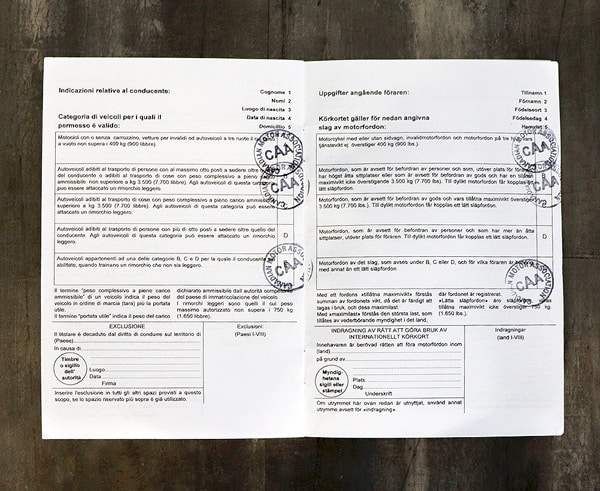
This goes without saying, but you need a valid driver’s license for any road trip through Mexico.
It must be written in English or Spanish, and valid for your entire trip.
⛔If your driver’s license is not in English, you will need to obtain an International Driving Permit instead. It is a relatively easy process but you will need to apply from your home country.
If you are pulled over by the police, they will ask to see your driver’s license, so make sure it is easily accessible.
2. Entry Requirements

If you are driving your vehicle into Mexico, you are required to have a tourist visa, proof of car insurance, and a TIP (temporary import permit).
Tourist Visa
To enter Mexico, you must obtain an FMM (Forma Migratoria Multiple or Tourist Visa) from customs.
It does not matter the length of days you are staying; you cannot enter Mexico without an FMM.
Unfortunately, the customs agents at the USA/Mexico border waved Gavin through without giving him an FMM card. This meant he did not have a valid FMM card when we tried to leave Mexico and enter Guatemala.
Even though it wasn’t our mistake, it became a big problem we needed to deal with to leave the country.
Ensure that when you enter Mexico, you are given an FMM card at the border. You can also purchase one online, but it will still need to be stamped at the Mexican border.
Car Insurance
Car insurance is mandatory for your entire Mexican road trip. And the chances of your car insurance from your home country covering you in Mexico are very slim.
Once you clear customs at the US/Mexico border, there are several car insurance agencies just waiting to sell insurance to you.
These are legitimate agencies and have different policies available.
✅HELPFUL TIP: You can also purchase your insurance online in advance. That is what we did.
We purchased a full car insurance policy with Lewis & Lewis Insurance for our 6–month road trip through Mexico. It costs CAD $450 or 6700 Pesos for the entire 6 months, which is cheaper than what we pay in Canada.
Temporary Import Permit
If you plan to bring your vehicle from Canada or the USA, you must obtain a Temporary Import Permit (TIP) at the Mexican border.
The cost of your TIP will depend on how long you plan to stay in Mexico. We planned on 6 months and our TIP cost $547 CAD or 8,133 Pesos.
✅HELPFUL TIP: You can purchase your TIP online from the Banjercito website 60 to 7 days before you enter Mexico.
Or you can purchase your TIP in person at the border in Banjercito.
👉Don’t worry, it’s just a deposit. Mexican authorities will refund the money when you exit the country. You must cancel your TIP at the border.
3. Safety Tips for Driving in Mexico

We had the same questions as you: Is it safe to drive in Mexico? Are the roads dangerous? What if we break down?
Before hitting the road, we spent hours researching what driving in Mexico is like.
Some of the online information we found made us extremely nervous about driving in Mexico. We planned on driving our own car after all.
When we drove through Puglia, it was no big deal. But when we shared our plans of driving through Mexico with our families, they thought we were crazy.
Despite driving around the Netherlands, France, Belgium, Italy, Greece, Namibia, Japan, and Malta, we didn’t know what to expect in Mexico.
But honestly, we think many online opinions were exaggerated.
👉After 6 months of driving in Mexico, we can honestly say that we feel just as safe as we did in other countries.
If you take the same precautions that you would in another foreign country, you should be fine.
Here are the most important safety tips we learned in Mexico.
Driving in Mexico Safety Tips
👉Never drive at night
👉Stick to the main highways
👉Keep your doors locked
👉Don’t leave money/valuables out
👉Never stop for strangers/hitchhikers
👉Have a car safety bag (jumper cables,
tools to change a tire, candles, snacks, & water)
We felt safe and immensely enjoyed our road trip through Mexico.
That doesn’t mean we never felt uneasy. You are still driving in a foreign country.
If you use common sense and follow the points in this guide, you will have an amazing journey too!
4. Highway Road Conditions

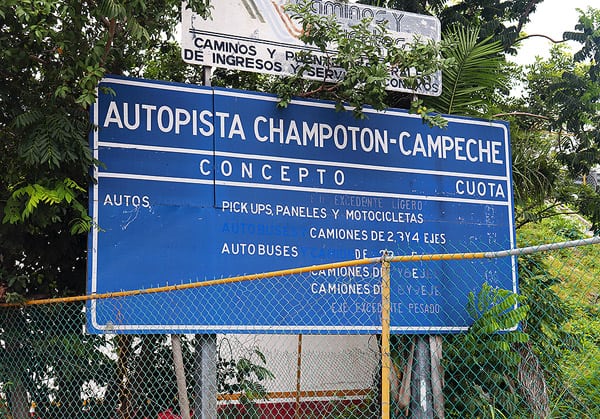
Major highways in Mexico are called Carretera Cuota. That is the name on the signs you want to look out for.
These highways are generally in good condition and well-maintained.
It is important to note that to drive on these highways you must pay a toll, which we talk about later.
✅HELPFUL TIP: Consider using cuota highways, as they are significantly faster than secondary highways.
We chose to drive on a secondary road on our way to Morelia, in the state of Michoacán. It was a horrible idea.
We were stuck behind a line of trucks going through tiny towns full of speed bumps. Lesson learned.
Whenever possible, stick to the major highways.
5. Secondary Road Conditions


Driving on a highway versus a secondary road is very different in Mexico.
Secondary roads are called Carretera Libre and they usually run parallel to major highways.
These roads are not taken care of. They can be rough, bumpy, sometimes with broken asphalt, and full of speed bumps.
There was even one point when the road we were on disappeared into a small creek. We had no choice but to drive through the water.
When in Mexico, I guess…
✅HELPFUL TIP: Although not frequent, roads may have broken asphalt. It’s important to make sure your car has enough clearance.
We recommend driving slower and using extra precautions. Even though conditions are not ideal, smaller cars will be fine. You don’t need an SUV.
⛔Watch for potholes. If you start noticing a lot of potholes, reduce your speed. Taking a pothole at a high speed can damage any car.
But really, it isn’t that different from anywhere else in North America. We live in Canada, and there are crazy potholes there too. Just be mindful.
6. Watch for Speed Bumps

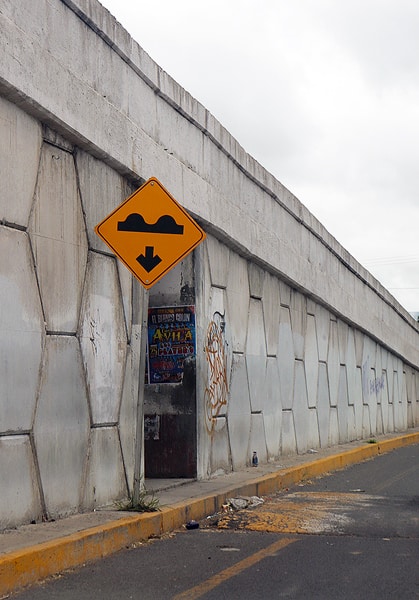
One of the most important Mexican driving tips is to watch out for speed bumps!
Called topes, these speed bumps are everywhere… and we mean, everywhere. On every road, in every city, town, and village.
They are a huge pain and can damage your car if taken too fast.
We can appreciate the use of speed bumps when entering a small town or approaching a dangerous curve.
However, speed bumps are severely overused in Mexico. It seems during road construction, if they were in doubt, they just added a speed bump.
Here are a few extra tips about speed bumps.
Inconsistent Signage
Unfortunately, signage is not consistently used throughout Mexico. Without a sign or painted white lines, the speed bumps are extremely difficult to see.
Of course, this increases the chance of damaging your vehicle or getting a shock to the system if you hit one by mistake.
Signs used to indicate speed bumps vary from standard signs to handmade painted signs to no sign at all. It is up to you to be vigilant.
Therefore, we do not recommend driving at night.
Speed Bump Placement
We noticed speed bumps are primarily used in places meant to slow drivers down. For example, entering and driving through a small town.
Traffic lights are not very common in small towns. Instead, they use stop signs and speed bumps.
Speed bumps can also be found on major highways even though there is no impending danger ahead.
Although it is meant to slow traffic, it can be very dangerous. We witnessed a few near-miss accidents because of improperly placed speed bumps.
Again, be cautious and mindful whenever you are driving in Mexico.
7. Speed Limits

Speed is a factor in every country. Fast drivers are everywhere, and impatience doesn’t seem to have a cultural barrier.
That is why you must always obey the speed limit.
All Mexican highways have posted speed limits. But it doesn’t mean everyone follows the rules.
In our 6-month Mexican road trip, we did not see anyone pulled over for speeding. It felt as though the speed limits were more a suggestion than a law.
⛔If you choose to speed, be forewarned that the chances of hitting a speed bump and damaging your car are high!
The longer we drove in Mexico, the slower our speed became.
Drive slowly to avoid unmarked speed bumps, potholes, other drivers, and pedestrians.
✅HELPFUL TIP: Speed limit signs in small towns are rare. So, if you don’t know, stick to 50km/h.
We found many people drive slower because the pesky speed bumps are everywhere.
8. Set Aside Money for Tolls

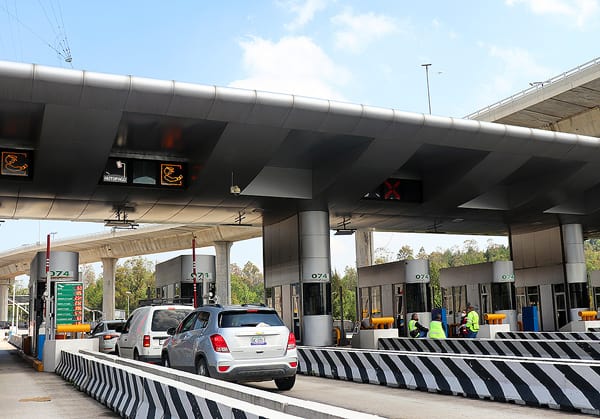
To use any major highway in Mexico, you must pay a toll. Don’t be surprised if you hit 5 or 6 tolls on a single journey.
And the tolls are not cheap!
Toll charges ranged from 35 Pesos ($1-2) up to 450 Pesos ($25-30)!
It surprised us how much the cost of tolls affected our day-to-day budget.
Another helpful Mexico driving tip is to set money aside in your budget specifically for tolls because they are costly.
It’s not the biggest deal breaker but just plan on spending a bit more than you would driving in the US, Canada, or a smaller country like Greece.
✅HELPFUL TIP: Keep cash and extra change with you or in the car at all times. Tolls are cash only.
And just because you pay a toll, doesn’t mean the highway will be in pristine condition.
There were countless times that we paid a high toll price and then found out 5 minutes later that the highway was full of potholes.
So where does the money go, Mexico?
9. Passing Other Drivers

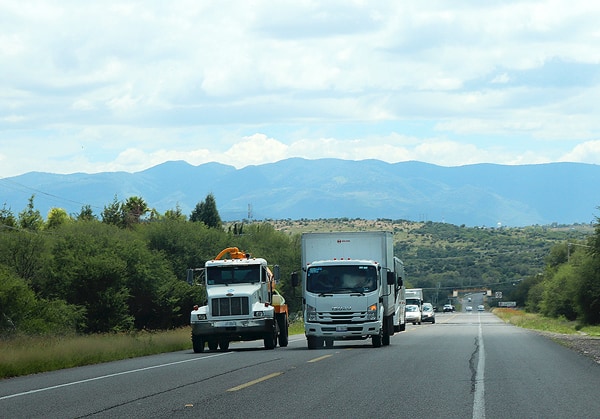
Passing other drivers, whether in the city or on the highway, is a whole other ballgame.
Although it can be terrifying, Mexican drivers have their unique system and it is up to us as visitors to learn it.
Don’t underestimate the impatience of drivers behind you.
We witnessed drivers move into oncoming traffic just to pass the car in front of them. This forces the unsuspecting driver onto the shoulder or curb just to avoid a collision.
It is insane and terrifying, so again… be prepared for anything!
Single Lane Highways
On single-lane highways, the more considerate, slower vehicles will move to drive on the shoulder. They do this as a courtesy to allow faster cars to pass.
If you notice a car wanting to pass you, move onto the shoulder and let them pass.
It can feel uncomfortable and frightening to do this, but you will be safer if you do.
To have a successful Mexican road trip, it is important to adopt Mexican driving habits, even if they don’t make sense to you.
Two Lane Highways
Though it is not as common on double-lane highways, it still happens. People will move onto the shoulder to let another driver pass.
We have seen two-lane highways become four-lane highways… Always stay alert!
✅HELPFUL TIP: Use your right signal to indicate you are moving onto the shoulder. Use your left signal to indicate you want to pass.

Passing Semi-Trucks
Large semi trucks are everywhere in Mexico, and their routes will overlap with yours guaranteed.
Unfortunately, we found most semi–truck drivers are not courteous. They don’t care about staying in the slow right lane.
They will often drive in the fast lane, even though they can’t keep up with traffic.
⛔ Semi–truck drivers do not consistently check their mirrors when passing other vehicles. We had to slam on our brakes many times because a semi–truck moved into our lane and cut us off.
Use extra caution when passing any large truck.
It is important to be cautious of all drivers, more than you would be driving in your home country.
Take your time, keep to the right when possible, and drive defensively.
10. The Rules of Driving

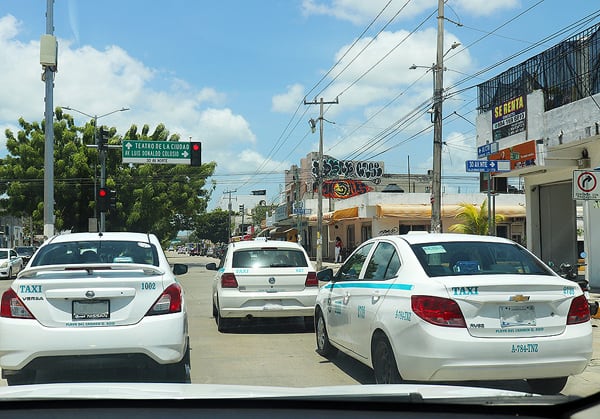
It is important to understand that some driving habits or expectations are different in Mexico. You must do your best to adapt… sort of.
Here are some of the biggest differences we have learned.
Green Lights
A green light at most intersections indicates “GO” for only ONE direction at a time.
For example, all vehicles traveling east are allowed to go on a green. This means that eastbound vehicles will turn left, right, and go straight all at once.
This is unlike North America, where turning lanes in both directions usually proceed at once.
Most roads in Mexico only have single green lights.
This just means you wait longer at the red light since all 3 directions need to have their turn.
Use of Blinkers
This is one of the more frustrating and puzzling habits of Mexican drivers.
After driving for 6 months in Mexico, we still have no idea what the actual “rule” is on blinkers.
Many drivers use their left blinker to indicate they are turning left.
But they also use their left blinker to indicate that you can go ahead and pass them on their left because they are turning right.
We know… confusing right?!
Hazard Lights
Again, this is not consistent among all drivers in Mexico.
We did notice Mexicans use their hazard lights to tell drivers behind them to slow down for construction or a delay.
Hazards are also used to double park.
Honking
If you don’t start driving a millisecond after a light turns green, expect the driver behind you to start honking.
Although annoying, it’s still better to take your time and make sure it is safe to go.
Retornos or U-Turns

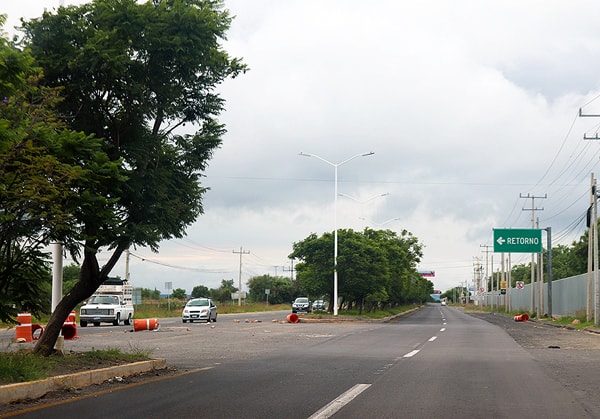
Another major difference with driving in Mexico is the U-turns.
Since most roads are in one direction, you will need to constantly be on the lookout for a U-turn to access the opposite direction.
Usually in Canada and the USA, U-turns are a definite no-no. In Mexico, it is common practice in most intersections.
Don’t be surprised if a U-turn lane suddenly turns into 3 cars turning at the same time.
This can be terrifying at first, as we are not used to a car to the right of us cutting us off to perform a left turn in front of our vehicle.
Extra vigilance people!
Pedestrian Crossings
In larger cities, it is common for pedestrians to use a crosswalk when crossing the street. But this is not always the case.
If in a small town, pedestrians cross whenever they feel it is safe to do so.
11. Driving in Mexico City


Okay, full disclosure, driving in Mexico City is intimidating. And no… we are not exaggerating.
We were both on high alert the entire time.
Driving in Mexico City felt a little like walking through a jungle safari with fresh meat strapped to our bodies. 😧
You need to be hypervigilant and constantly monitor the movements of every other car on the road. It can be exhausting but exhilarating!
For example, we drove on a 3–lane major road through Mexico City. Beside us was a 2–lane road going the same direction. And, there was 3–lane express toll highway above us. It was insane!
Mexico City Roads Cheat Sheet:
🔹Main 3–Lane Road: major thoroughfare through the city
🔹Raised 3–Lane Toll Highway: express toll road with no traffic lights
🔹Parallel 2–Lane Road: used for turning lanes, or when you can’t maintain the speed of the main 3–lane road
We recommend you drive on whichever road makes sense for your destination and that you are comfortable with.
Sometimes traffic moves so fast it can be difficult to know where you need to be and when. Flexibility and driving defensively is important!
Thankfully, major roads are well–marked and most of the signs are clear(ish).
12. Driving in Large Cities

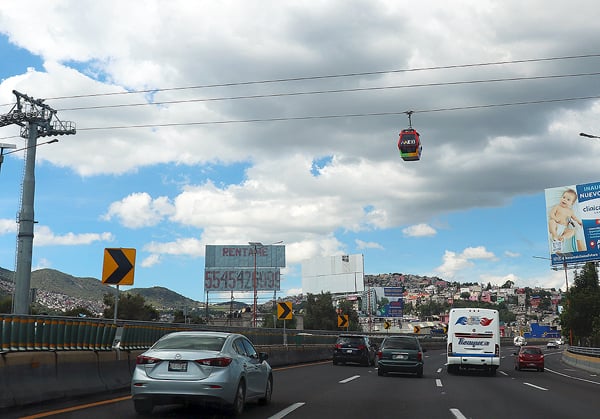
Although not as intense, we would argue that Acapulco, Puerto Vallarta, Cancun, Queretaro, Guanajuato, Guadalajara, Puebla, Culiacán, and even Tulum have “big city” driving issues too.
👉What to Expect When Driving in Large Cities
✔️Major roads can be several lanes wide
✔️People will turn right/left from the middle lane
✔️Buses will pick up/drop off in the right lane
✔️Many cities have a one–way road system
✔️Street signs with directional arrows
✔️Motorbikes weaving in/out of traffic
✔️Speed bumps everywhere
✔️Not all speed bumps have crosswalks
✔️Not all speed bumps are marked
✔️People park on the sidewalks
Speed cameras are also common in larger cities. However, they are not manned, so who knows if they are always operational.
It is better to be safe than sorry, so watch your speed.
13. Parking in Large Cities

It can be difficult to find parking in some areas within larger cities. It is common for private home garages to line roads. And you can not park in front of a garage.
There are usually paid parking lots near hotels, museums or the historic center. The parking lot fee is very affordable.
Street parking is still common, so always keep an eye out for a free spot!
We were able to find free street parking when visiting Pachuca and Santiago de Querétaro in Central Mexico.
✅HELPFUL TIP: Make sure you always park in a legal zone marked with an “E”, as police officers do patrol the larger cities.
14. Driving in Small Towns

Here are a few Mexico driving tips for smaller towns.
Don’t expect roads in smaller towns to be good or well maintained. They are often narrow, windy, and full of potholes.
And remember, speed bumps are excessively used in small towns.
Cobblestones or bricks are commonly used in the historic centers of most small towns. This is especially true in smaller villages or Pueblo Magicos like Huasca de Ocampo.
Don’t be alarmed if a paved road suddenly ends and you end up driving on dirt, partial pavement, or even grass.
Tulum is notorious for its terrible roads. The more construction and development happening in the town, the larger the trucks and more horrible the roads are.
If you travel with chronic pain like I do, prepare yourself for a very bumpy ride.
✅HELPFUL TIP: If you drive a small vehicle with little clearance, avoid dirt roads. They usually have large potholes and will damage your vehicle’s undercarriage. Research your route beforehand.
15. Parking in Small Towns

We never had any issues parking in small towns or Pueblo Magicos. And we visited over 20 of them on our Mexican road trip.
Usually, we were able to find free street parking in or very close to the historic center.
In tourist hotspots or more popular towns, like Bernal, San Miguel de Allende, or Guanajuato, parking may be restricted.
But we always found a local parking lot nearby. These parking lots are safe and secure with a guard on duty and are very affordable.
16. Slow vs. Fast Drivers

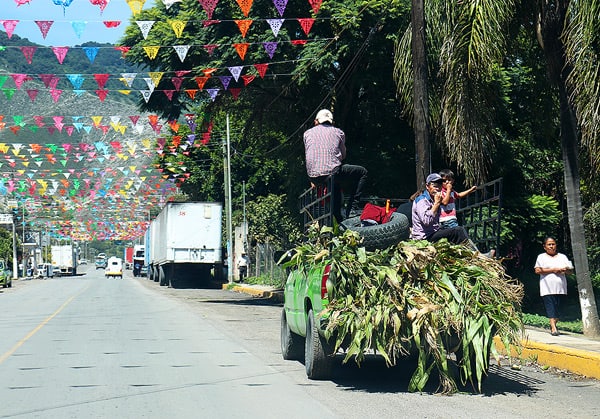
Mexico has a huge population, and with that comes more impatience and, unfortunately, more stupidity.
There is an abundance of unpredictability on Mexican roads because of how people choose to drive.
We encountered 3 types of drivers – regular, slow, and aggressive.
Slow Drivers
Whether you are driving in a town, city, or highway, some drivers are incredibly slow. I mean… snail’s pace.
We witnessed many people driving 15km/h in a major city where the speed limit was 50km/h.
This means the right lane can be painfully slow.
⛔People will drive insanely slow on highways too. We witnessed a person driving 30 km/h on a 100km/h highway! It was very scary and almost caused an accident. Never drive when you are tired and always stay alert!
We never understood why people drove dangerously slow in Mexico. But it happens.
You will see cars that do not belong on the road and trucks so heavily overloaded with cargo they can’t speed up past 20 km/h.
Container trucks have no weight limit. So they pack them high and heavy. So heavy that they can’t make it up a hill. I remember walking faster than a container truck once.
Yup, you’re in Mexico, now!
Aggressive Drivers
Although the majority of highway drivers are good, you will come across drivers who think they are on a Formula One race track.
For some reason, as you approach a (big or small) town, more drivers turn into speed demons.
Aggressive drivers find it difficult to stay in one lane. They are constantly swerving left and right to find out who is holding them up.
They will follow extremely close to your bumper until you get out of their way.
We even experienced a desperate driver venture onto the shoulder to pass us because we didn’t pull over fast enough!
Always watch your mirrors and pay attention to the cars around you.
17. Driving Distances


Google Maps and our GPS provide pretty accurate driving times in Mexico.
Having said that, driving in Mexico is mentally draining and exhausting.
Make sure you are rested for the journey ahead. You need to stay alert to avoid potholes, speedbumps, people, and animals on the roads.
We limit our driving time to a maximum of 5 hours. Although I can drive for 10 hours in Canada, I do not recommend that here.
Driving in Mexico is just more demanding on the driver.
✅HELPFUL TIP: When planning a trip, keep your drives shorter than you used to. Take your time, stop for breaks, and remember that you are on vacation!
18. Use a GPS or Google Maps

We always recommend driving with a reliable GPS.
Driving with a GPS can help:
👉track your speed
👉annouce upcoming turns
👉indicate the location of gas stations
👉alert you of potential photo radar
However, a GPS is not perfect.
In Mexico City, our GPS had a difficult time tracking our exact location.
When we were driving on a major 3–lane road, our GPS had us on the raised 3–lane express highway above us. This caused a lot of confusion since there was another 2–lane road beside us, all going in the same direction.
Our GPS could not discern which of the 8 lanes we were on!
Thankfully, this was only a problem in Mexico City.
But it is important to be flexible. If you miss a turn… it’s no big deal. As I always say, “Stay calm and drive on, we will get there”.
19. Car Maintenance

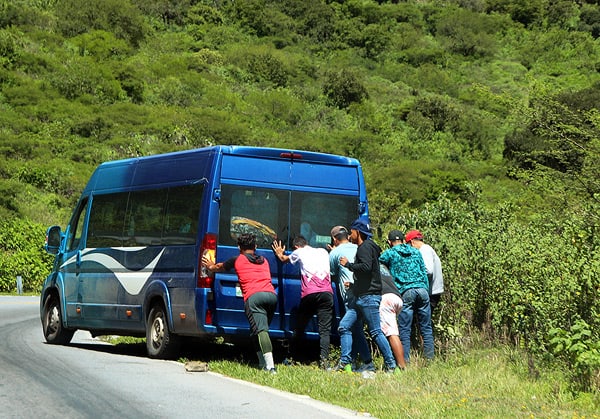
Another important tip for driving in Mexico is to maintain your vehicle.
Before we left Canada, we had our car serviced, the tires/brakes checked, and topped up with necessary fluids.
Car Dealerships
Most car dealerships can be found in bigger cities in Mexico. This is important, especially if you require specialty work done on your vehicle.
Thankfully we didn’t have major problems on our Mexican road trip.
We did get an oil change at the Chevrolet dealership in downtown Mexico City. Yup, our wrong turn took us right to a dealership.
Oil Changes
Getting an oil change was fast and easy in Mexico.
Of course, you can get an oil change almost anywhere in Mexico. Most local shops in small towns offer tire and oil changes.
It was just our preference (and language barrier) on why we chose a dealership.
Tire Changes
After driving over so many potholes, you may end up with a flat tire. Make sure you have the necessary tools to change a tire.
✅HELPFUL TIP: We purchased a full spare tire before our 6–month Mexican road trip. Do what you can to prepare your vehicle and reduce stress before hitting the road.
Every gas station also sells oil and has a tire air pump.
After a few weeks of driving in Mexico, we felt much safer knowing that a gas station was never too far away if we needed help.
20. Gas Stations

Gas stations are plentiful in Mexico. There is usually a Pemex around the next corner with a convenient Oxxo attached.
We never worried if we had a ¼ of a gas tank left. But we wouldn’t push it beyond that. You know, safety first!
Most gas stations accept credit cards. No need to waste that toll money on filling up your gas tank!
✅HELPFUL TIP: You should tip your gas attendant. A few pesos are much appreciated. And you cannot add a tip to your credit card.
Paying with a credit card allows you to rack up travel reward points and save money for your next trip!
⛔Watch out for shady gas attendants who will begin to fill your tank from a number other than zero, charging you for gas you didn’t need.
We were never taken advantage of, but a nice gas attendant warned us of this scam.
We found that many gas attendants will point to the 0.00 on the screen to show they are honest.
21. Vendors, Washers & Children

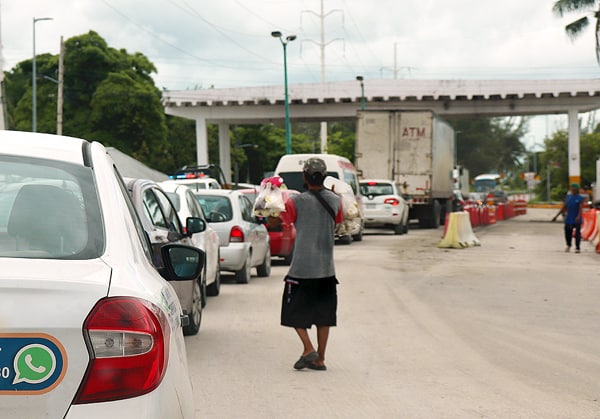
Whether you are crawling over a speed bump or stopped at a light, the chances of interacting with locals while on the road are high.
Street Vendors
Street vendors hang out by speed bumps on major roads throughout Mexico.
As you slow down, vendors take this opportunity to try and sell you drinks, snacks, toys, and car accessories.
Don’t be alarmed or scared. This is a common practice in Mexico. People are just trying their best to make a living.
Locals frequently purchase items, so don’t hesitate to do the same. It was rare that vendors sold items we wanted… but that’s just us.
Window Washers
Another common practice is having someone wash your windshield at a red light.
Honestly, they do a great job! We used their quick washing service several times. Just make sure to tip!
We also found they were kind and respectful if you declined. No one yelled or swore at us once.
Children Selling Items
Sadly, you will see children selling items on the street or begging for money. This was one thing we did not want to support.
Please don’t give children money. They are forced to sell during the day when they should be in school.
We learned the money goes to their “parents” and they never see much of it themselves.
Although it is painful to watch, we cannot support parents who send their kids out to make money for the family.
It’s just not right, but that is our opinion.
22. The Mexican Police

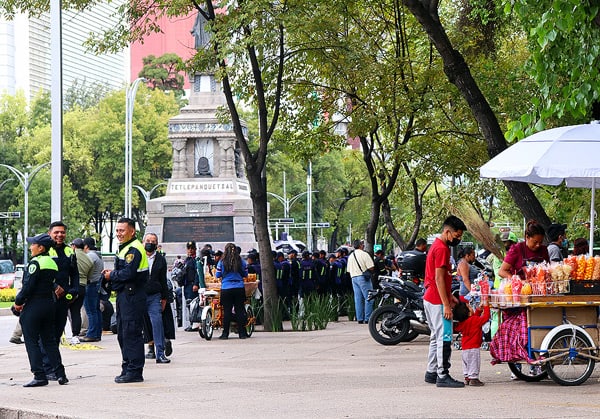
Police in every country can be intimidating. It’s part of their job after all, but they are there to help.
Despite feeling intimidated at times, we did not have any issues with the police while driving in Mexico.
Generally, they are pleasant and only want to know where you are headed.
Of course, all of this is in Spanish. It was rare to encounter a policeman who spoke English.
We were stopped a few times because our Canadian SUV only had a license plate on the back. In Mexico, it is mandatory to have a license plate on the front and back of your vehicle.
The police would inquire about our license plate and ask for our driver’s license. Once we explained that we were visiting from Canada, and showed proof of registration, we were free to go.
✅HELPFUL TIP: Make sure you have all the necessary paperwork (license, registration, insurance, FMM & TIP) in order and ready to present to any police officer who asks.
Expect to see groups of police in full gear and with visible weapons. They are usually on the side of the road as you enter/exit a town or state.
Before our Mexican road trip, we read horror stories of police officers taking bribes from tourists.
⛔Police officers asking for a bribe does happen. It is important to stay calm and know what to do.
We experienced a police officer asking for a bribe while driving in Bucerías, Nayarit during the 5th month of our journey.
👉If you are being asked to pay a fine (or bribe), request to go to the police station or traffic processing office. They will try to dissuade you and say you can pay the fine there.
👉Be persistent. Insist you that you will pay for the ticket at the traffic processing office.
👉If they are dishonest, they will make an excuse and let you go. That is exactly what happened to us.
The entire encounter was in Spanish, so it is important to learn a little Spanish before heading to Mexico.
23. Unexpected Delays


Before beginning any Mexican road trip, it is important to research road conditions and weather.
Unfortunately, getting live updates in English can be especially difficult in Mexico, but it doesn’t hurt to try.
Weather
Rain isn’t a huge problem unless you plan to drive in the mountains. When heavy rains come, flooding of the road is common.
Even in larger cities like Playa Del Carmen, we experienced a couple of storms that caused huge flooding on the highway.
✅HELPFUL TIP: If rain is in the forecast, avoid a long drive if you can.
Construction
Unfortunately, construction was everywhere in Mexico.
There wasn’t a single driving day we didn’t experience some kind of construction. Thankfully, the delays don’t last too long.
✅HELPFUL TIP: Expect lane closures and alternating traffic when there is construction.
Accidents

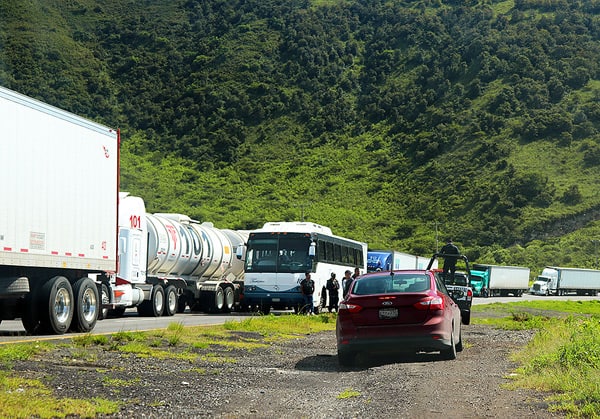
As in any country, accidents can and do happen. This can cause long delays, especially on single-lane highways.
✅HELPFUL TIP: Be prepared for an accident or delay: carry water, snacks, and a cell phone charger.
We were affected by a major accident while driving on a mountainous 2–lane highway. You can see the lineup of large trucks in the picture.
The line didn’t move for over an hour. Thankfully, Robyn used her Spanish skills to befriend a guy next to us. Then, as luck would have it, a police truck showed up.
Suddenly, we were following our new Mexican friend and the police past the line of cars, through dirt and grass onto a different highway. Crazy!
Of course, this is not a usual occurrence. Road closures can take many hours. Don’t leave yourself vulnerable in your car without supplies.
24. Everyday Conveniences

You’re in Mexico now, so don’t expect to see your local 7–11 around.
Mexico does have convenience stores, like Oxxo. However, they can be difficult to find in some towns or parts of the country.
Carrying a few essentials with you is important because many items are not as common to find in Mexico as they may be back home.
Water
Water is an essential item on any road trip, especially in Mexico since you can’t drink tap water.
Make space in your vehicle to carry a large 5L jug of water with you.
Reusable Water Bottle
One thing Mexico has too much of is empty plastic bottles. Expect to see them scattered along the road or thrown in bushes.
We need to help where we can, so bring a reusable water bottle with you.
Purchase a 5L jug of water from Oxxo, and fill your reusable bottles on long journeys.
✅HELPFUL TIP: Most Oxxo’s participate in an exchange program for 5L water jugs. Just bring your empty one in and exchange it for a new jug. Then you are not adding to the landfill with small plastic bottles.
Toilet Paper
Unfortunately, the chances of finding toilet paper in a bathroom stall are slim.
We always carried a roll in the car to use in the restroom or when I needed to pee on the side of the road. Yup… get prepared for that too!
Make sure to throw the toilet paper in the trash after use, and not the toilet. Their plumbing system can’t handle it.
Coffee
Not all Oxxo convenience stores are 24/7, even if the sign says so.
If your hotel doesn’t provide it, or you don’t make it, you may be going without your morning coffee for a couple of hours.
Restaurants
Restaurants can be difficult to find in some areas of Mexico. Unlike North America, McDonald’s is not on every corner.
Yes, you will find local taco stands scattered along the road, but that novelty will wear off quickly.
We prefer to buy groceries and pack a lunch.
Not only does this help spend less money while traveling, but you will always have snacks in the car!
Travel Pillow
A travel pillow is essential when surviving air travel and road trips.
Whether it’s a U-shaped neck pillow or a mini memory foam pillow, find what resources help you manage your pain.
Compression Leggings
My chronic pain and fibromyalgia have changed the way I travel.
If you have POTS or experience swollen legs, nerve pain, or circulation issues when sitting for extended periods, then consider compression leggings.
They work to improve circulation pressure to the veins in your lower legs, helping to push the blood upwards so it doesn’t pool.
Sea Bands
If you get car sick, try Motion Sickness Wristbands from the Sea Band company. They are the most effective in reducing my car sickness.
Medication
A given for anyone traveling with chronic pain. We always carry Extra Strength Tylenol and Extra Strength Advil for any length of the trip.
25. Limited Rest Stops

Unfortunately, designated rest stops and pullouts are lacking in Mexico.
We don’t understand why either… as the countryside is beautiful and deserves a photo or two!
If you find an amazing view, just know you may have to pull over in an unsafe area on the highway, or just skip it.
We drove down the entire Pacific Highway and never found a planned lookout/pull-over location. It was disappointing… but just the reality of it.
Should You Drive in Mexico?

Based on our experience of driving around Mexico for 6 months… YES, go on an epic Mexican road trip!
We drove from the USA/Mexico border to Guatemala with a foreign plate and only had a few scratches… mostly because our vehicle couldn’t compete with a narrow alley!
Despite different rules and driving habits… Mexico is safe and relatively easy to drive in.
Most roads are in “good” condition, GPS works well, people are friendly, and Mexico is a beautiful country.
Many of the gorgeous places we explored would not have been possible without a car… and these have become our favorites, like colorful Pachuca!
Just ensure you are rested, exercise more caution, and stay alert while driving in Mexico.
Never drive at night, hide your valuables, and make sure your hotel provides secure parking.
Stay mindful and you will have an amazing Mexico road trip too!
FAQ’s: Mexico Driving Tips
Can I drive my car in Mexico as a tourist?
Yes, tourists can drive their own vehicle in Mexico, but you’ll need a Temporary Import Permit (TIP) if traveling beyond the border zone. You obtain this after crossing the border, and it’s essential — forgetting it can cause serious issues later.
Is it easy to drive in Mexico?
Generally, yes. Most highways and major roads in Mexico are paved and well maintained. The biggest adjustment for many drivers is watching for topes (speed bumps), which are common in towns and can appear with little warning.
What should I know before driving through Mexico?
Drive defensively, obey speed limits, and stay alert for road conditions, animals, and unmarked speed bumps. Planning your routes in advance and avoiding night driving can make your road trip far smoother.
How do you pay tolls in Mexico?
Most toll roads in Mexico accept cash only, so it’s important to carry Mexican pesos. Toll booths are frequent on major highways, and change isn’t always guaranteed.
What should I do if I get pulled over in Mexico?
Remain calm and respectful. If you’re issued a fine, ask to pay it at the police station, not roadside. Legitimate fines are paid officially, and this helps avoid misunderstandings.
How much do toll roads in Mexico cost?
Toll costs vary depending on distance and region, typically ranging from $5 to $60+ USD per toll. Longer highway stretches can add up quickly, so budget accordingly.
Final Thoughts: Tips for a Mexican Road Trip
Our road trip through Mexico was incredible! We experienced more of this country than we ever thought possible.
Driving in Mexico has allowed us to explore the lesser-visited destinations, travel at our own pace, and experience the Mexican culture up close!
Hopefully, these 25 Mexico driving tips have been helpful, informative, and convinced you to pack it all up and embark on your own Mexican adventure!

Read More on Mexico
A Detailed Travel Guide to Visiting Huasca de Ocampo in 2025
10 Reasons Why Pachuca is Worth Visiting in 2025
The 10 Best Things to Do in Pachuca, Hidalgo
14 Travel Tips: How to Spend Less While Traveling
How to Plan a Trip With Chronic Pain and Fatigue
